Overview
clmstan supports 11 link functions for cumulative link models—more than any other CLM package. This article explains: - The mathematical properties of each link function - Visual comparison of their CDFs - How to choose the best link for your data
Link Functions at a Glance
Standard Links (5)
Standard links have no adjustable parameters:
| Link | Distribution | Characteristics |
|---|---|---|
| logit | Logistic | Default, proportional odds interpretation |
| probit | Normal | Symmetric, latent variable interpretation |
| cloglog | Gumbel (max) | Right-skewed, proportional hazards |
| loglog | Gumbel (min) | Left-skewed |
| cauchit | Cauchy | Heavy tails, robust to outliers |
Flexible Links (6)
Flexible links have parameters that can be fixed or estimated from data:
| Link | Parameters | Special Cases |
|---|---|---|
| tlink | : probit | |
| aranda_ordaz | : logit; : cloglog | |
| gev | : loglog (Gumbel) | |
| sp | , base | : base distribution |
| log_gamma | : probit | |
| aep | : similar to probit |
supported_links()
#>  [1] "logit"        "probit"       "cloglog"      "loglog"       "cauchit"
#>  [6] "tlink"        "aranda_ordaz" "gev"          "sp"           "log_gamma"
#> [11] "aep"
Visual Comparison
The cumulative distribution function (CDF) determines how probabilities are mapped to the latent scale. Different CDFs produce different model behavior, especially for extreme categories.
Standard Link CDFs
x <- seq(-4, 4, length.out = 200)

cdfs <- data.frame(
  x = x,
  logit = plogis(x),
  probit = pnorm(x),
  cloglog = 1 - exp(-exp(x)),
  loglog = exp(-exp(-x)),
  cauchit = pcauchy(x)
)

par(mar = c(4, 4, 2, 1))
plot(x, cdfs$logit, type = "l", lwd = 2, col = 1,
     xlab = "x", ylab = "F(x)", main = "Standard Link CDFs",
     ylim = c(0, 1))
lines(x, cdfs$probit, lwd = 2, col = 2)
lines(x, cdfs$cloglog, lwd = 2, col = 3)
lines(x, cdfs$loglog, lwd = 2, col = 4)
lines(x, cdfs$cauchit, lwd = 2, col = 5, lty = 2)
legend("bottomright",
       legend = c("logit", "probit", "cloglog", "loglog", "cauchit"),
       col = 1:5, lwd = 2, lty = c(1, 1, 1, 1, 2))
abline(h = 0.5, lty = 3, col = "gray")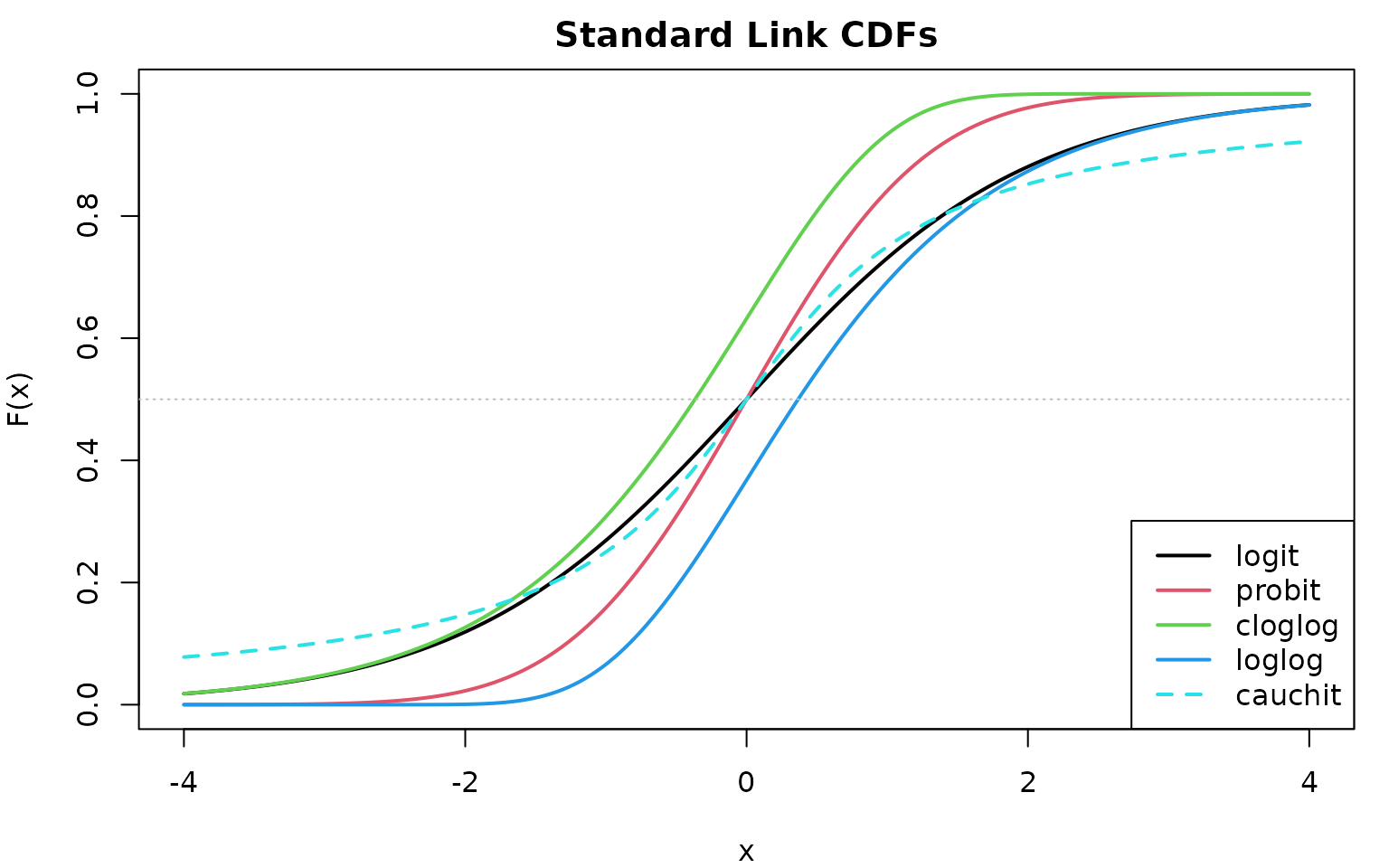
Key observations:
- logit and probit: Nearly identical symmetric curves
- cloglog: Right-skewed (slower approach to 1)
- loglog: Left-skewed (slower approach to 0)
- cauchit: Heavy tails (slower approach to both 0 and 1)
t-link: Adjustable Tail Weight
The t-link interpolates between cauchit () and probit ():
x <- seq(-4, 4, length.out = 200)

par(mar = c(4, 4, 2, 1))
plot(x, pnorm(x), type = "l", lwd = 2, col = "black", lty = 2,
     xlab = "x", ylab = "F(x)", main = "t-link CDFs (varying df)",
     ylim = c(0, 1))
lines(x, pt(x, df = 1), lwd = 2, col = 2)
lines(x, pt(x, df = 2), lwd = 2, col = 3)
lines(x, pt(x, df = 3), lwd = 2, col = 4)
lines(x, pt(x, df = 4), lwd = 2, col = 5)
lines(x, pt(x, df = 8), lwd = 2, col = 6)
lines(x, pt(x, df = 30), lwd = 2, col = 7)
legend("bottomright",
       legend = c("probit (df=Inf)", "df=1 (Cauchy)", "df=2", "df=3",
                  "df=4", "df=8", "df=30"),
       col = c(1, 2:7), lwd = 2, lty = c(2, rep(1, 6)))
abline(h = 0.5, lty = 3, col = "gray")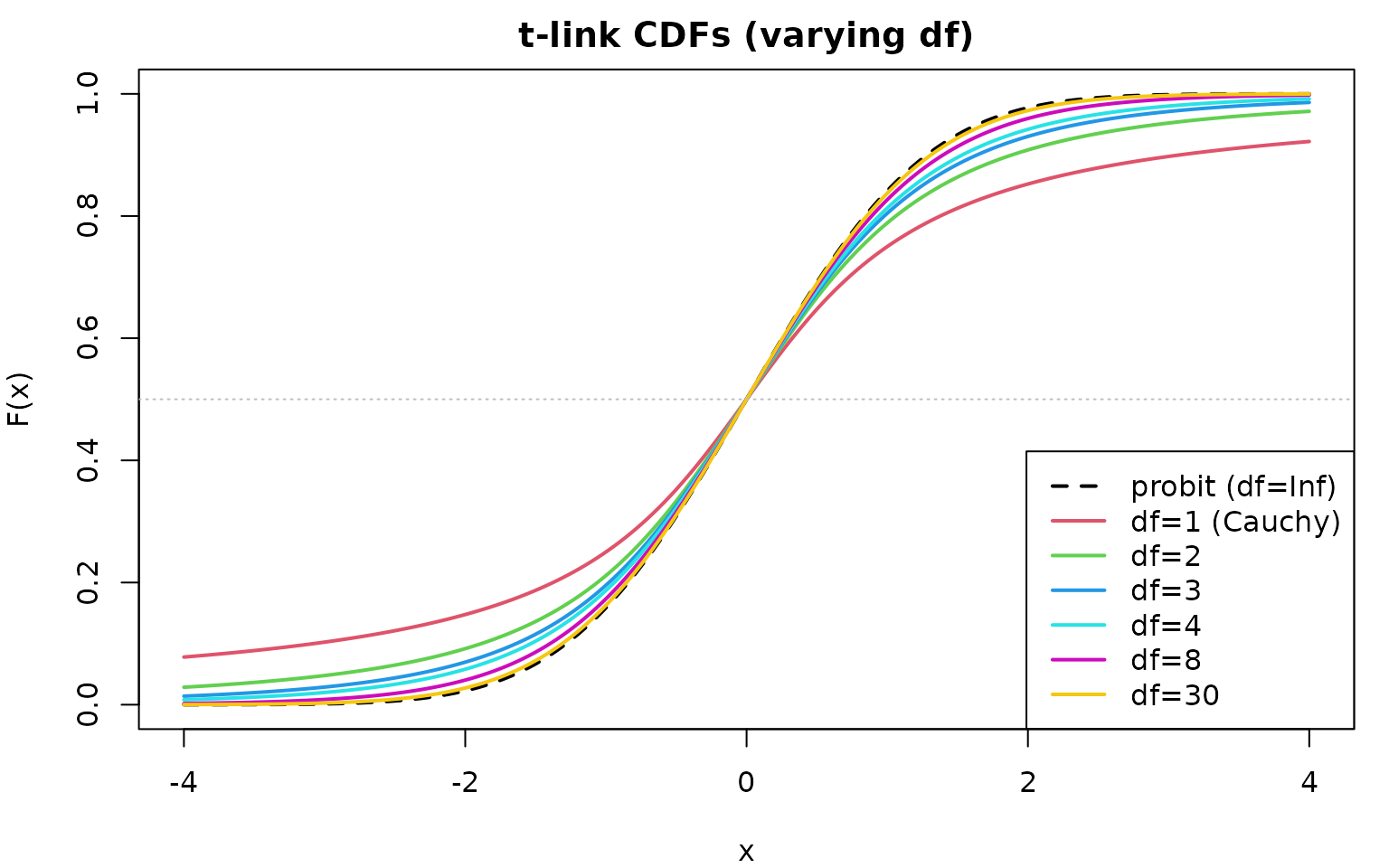
Guidelines for df:
| df | Tail behavior | Equivalent to |
|---|---|---|
| 1 | Very heavy | cauchit |
| 2–3 | Heavy | — |
| 4–8 | Moderate | — |
| Light | probit |
Other Flexible Links
Aranda-Ordaz:
- : Equivalent to logit
- : Approaches cloglog
- Useful for testing proportional odds assumption
GEV (Generalized Extreme Value):
- : Gumbel type (equivalent to loglog)
- : Fréchet type (heavy upper tail)
- : Weibull type (bounded upper tail)
SP (Symmetric Power):
- : Base distribution (e.g., logit)
- : Positively skewed
- : Negatively skewed
Log-Gamma:
- : Equivalent to probit
- : Heavier right tail
- : Heavier left tail
AEP (Asymmetric Exponential Power):
- : Shape parameters controlling left and right tails
- : Similar to probit (normal-like)
- : Laplace-like (heavier tails)
- : Asymmetric tails
Practical Comparison
Fitting Models with Different Links
We compare link functions using the wine dataset. First,
we fit models with the five standard links:
set.seed(42)

fit_logit <- clm_stan(rating ~ temp + contact, data = wine, link = "logit",
                      chains = 2, iter = 1000, warmup = 500, refresh = 0)

fit_probit <- clm_stan(rating ~ temp + contact, data = wine, link = "probit",
                       chains = 2, iter = 1000, warmup = 500, refresh = 0)

fit_cloglog <- clm_stan(rating ~ temp + contact, data = wine, link = "cloglog",
                        chains = 2, iter = 1000, warmup = 500, refresh = 0)

fit_loglog <- clm_stan(rating ~ temp + contact, data = wine, link = "loglog",
                       chains = 2, iter = 1000, warmup = 500, refresh = 0)

fit_cauchit <- clm_stan(rating ~ temp + contact, data = wine, link = "cauchit",
                        chains = 2, iter = 1000, warmup = 500, refresh = 0)
Next, we fit models with the six flexible links. These links have parameters that are estimated from the data:
fit_tlink <- clm_stan(rating ~ temp + contact, data = wine, link = "tlink",
                      link_param = list(df = "estimate"),
                      chains = 2, iter = 1000, warmup = 500, refresh = 0)

fit_aranda <- clm_stan(rating ~ temp + contact, data = wine, link = "aranda_ordaz",
                       link_param = list(lambda = "estimate"),
                       chains = 2, iter = 1000, warmup = 500, refresh = 0)

fit_gev <- clm_stan(rating ~ temp + contact, data = wine, link = "gev",
                    link_param = list(xi = "estimate"),
                    chains = 2, iter = 1000, warmup = 500, refresh = 0)

fit_sp <- clm_stan(rating ~ temp + contact, data = wine, link = "sp",
                   base = "logit", link_param = list(r = "estimate"),
                   chains = 2, iter = 1000, warmup = 500, refresh = 0)

fit_loggamma <- clm_stan(rating ~ temp + contact, data = wine, link = "log_gamma",
                         link_param = list(lambda = "estimate"),
                         chains = 2, iter = 1000, warmup = 500, refresh = 0)

fit_aep <- clm_stan(rating ~ temp + contact, data = wine, link = "aep",
                    link_param = list(theta1 = "estimate", theta2 = "estimate"),
                    chains = 2, iter = 1000, warmup = 500, refresh = 0)
Model Comparison with LOO-CV
We use leave-one-out cross-validation (LOO-CV) to compare predictive performance across all 11 models:
# Compute LOO for standard links
loo_logit <- loo(fit_logit)
loo_probit <- loo(fit_probit)
loo_cloglog <- loo(fit_cloglog)
loo_loglog <- loo(fit_loglog)
loo_cauchit <- loo(fit_cauchit)

# Compute LOO for flexible links
loo_tlink <- loo(fit_tlink)
loo_aranda <- loo(fit_aranda)
loo_gev <- loo(fit_gev)
loo_sp <- loo(fit_sp)
loo_loggamma <- loo(fit_loggamma)
loo_aep <- loo(fit_aep)
# Compare all 11 link functions (sorted by expected log predictive density)
loo_list <- list(
  logit = loo_logit,
  probit = loo_probit,
  cloglog = loo_cloglog,
  loglog = loo_loglog,
  cauchit = loo_cauchit,
  tlink = loo_tlink,
  aranda_ordaz = loo_aranda,
  gev = loo_gev,
  sp = loo_sp,
  log_gamma = loo_loggamma,
  aep = loo_aep
)
loo::loo_compare(loo_list)
#>         model elpd_diff se_diff p_worse diag_diff       diag_elpd
#>        probit       0.0     0.0      NA
#>         tlink      -0.5     0.4    0.93   N < 100
#>         logit      -0.6     0.5    0.89   N < 100
#>           gev      -0.9     0.4    0.98   N < 100
#>       cloglog      -1.0     1.6    0.73   N < 100 2 k_psis > 0.67
#>            sp      -1.3     0.6    0.99   N < 100
#>  aranda_ordaz      -1.3     0.5    0.99   N < 100
#>        loglog      -2.3     1.8    0.90   N < 100 1 k_psis > 0.67
#>           aep      -5.1     1.5    1.00   N < 100
#>     log_gamma      -5.9     1.2    1.00   N < 100 2 k_psis > 0.67
#>       cauchit      -7.6     2.7    1.00   N < 100
How to interpret:
- Models are sorted by expected log predictive density (best first)
-
elpd_diff: Difference from the best model (0 = best) -
se_diff: Standard error of the difference - Rule of thumb: If , the difference is not significant
Note: WAIC (Widely Applicable Information Criterion)
is also available via waic(fit). LOO-CV is generally
preferred as it provides diagnostics for problematic observations
(Pareto k values).
Interpreting Results
Coefficient comparison across standard links:
coefs <- data.frame(
  logit = coef(fit_logit),
  probit = coef(fit_probit),
  cloglog = coef(fit_cloglog),
  loglog = coef(fit_loglog),
  cauchit = coef(fit_cauchit)
)
round(coefs, 3)
#>            logit probit cloglog loglog cauchit
#> 1|2        0.000  0.000   0.000  0.000   0.000
#> 2|3        2.678  1.559   2.185  1.520   5.042
#> 3|4        4.918  2.888   3.656  2.977   7.330
#> 4|5        6.527  3.824   4.557  4.259   9.660
#> tempwarm   2.458  1.521   1.631  1.551   2.126
#> contactyes 1.501  0.877   0.879  0.899   1.310
Note: Coefficients are on different scales depending on the link function. Direct comparison of magnitudes is not meaningful; compare signs and relative importance instead.
Estimated link parameters for flexible links:
# Combine all flexible link parameter estimates into one table
link_params_all <- rbind(
  cbind(link = "tlink", summary(fit_tlink)$link_params),
  cbind(link = "aranda_ordaz", summary(fit_aranda)$link_params),
  cbind(link = "gev", summary(fit_gev)$link_params),
  cbind(link = "sp", summary(fit_sp)$link_params),
  cbind(link = "log_gamma", summary(fit_loggamma)$link_params),
  cbind(link = "aep", summary(fit_aep)$link_params)
)
link_params_all
#>           link variable       mean         sd       2.5%         50%      97.5%
#> 1        tlink       df 19.9512987 15.1321539  2.9847032 15.71479200 59.2091042
#> 2 aranda_ordaz   lambda  1.1162084  1.0284254  0.2799335  0.81190743  4.0844419
#> 3          gev       xi -0.2751134  0.1721647 -0.6038121 -0.27820272  0.0847995
#> 4           sp        r  1.0396368  0.3859994  0.4388587  0.98611015  2.0196172
#> 5    log_gamma   lambda -0.1504433  0.5825221 -1.6059357 -0.02311868  0.6245536
#> 6          aep   theta1  1.0214931  0.7757722  0.3074226  0.76960103  3.0987387
#> 7          aep   theta2  1.2506271  1.0471035  0.3373869  0.90380527  4.0876131
#>        rhat   ess_bulk ess_tail
#> 1 0.9999437 670.638466 583.9592
#> 2 1.0098237 239.821331 271.2428
#> 3 1.0017794 390.305936 363.2442
#> 4 1.0018915 250.191143 322.1370
#> 5 1.8432617   3.011494  86.3296
#> 6 1.0005935  55.724476 147.1933
#> 7 1.0234559  59.789756 127.8718
Quick Reference
| Link | Usage | When to use |
|---|---|---|
| logit | link = "logit" |
Proportional odds model |
| probit | link = "probit" |
Latent normal variable |
| cloglog | link = "cloglog" |
Right-skewed; proportional hazards |
| loglog | link = "loglog" |
Left-skewed; mirror of cloglog |
| cauchit | link = "cauchit" |
Heavy-tailed errors |
| tlink | link = "tlink", link_param = list(df = "estimate") |
Adjustable tail weight |
| aranda_ordaz | link = "aranda_ordaz", link_param = list(lambda = "estimate") |
Logit-cloglog interpolation; is logit |
| gev | link = "gev", link_param = list(xi = "estimate") |
Unconstrained skewness; gives loglog |
| sp | link = "sp", base = "logit", link_param = list(r = "estimate") |
Adjustable skewness |
| log_gamma | link = "log_gamma", link_param = list(lambda = "estimate") |
Generalized probit; is probit |
| aep | link = "aep", link_param = list(theta1 = "estimate", theta2 = "estimate") |
Independent tail shapes |
References
- Agresti, A. (2010). Analysis of Ordinal Categorical Data (2nd ed.). Wiley.
- Albert, J.H., & Chib, S. (1993). Bayesian analysis of binary and polychotomous response data. Journal of the American Statistical Association, 88(422), 669–679.
- Aranda-Ordaz, F.J. (1981). On two families of transformations to additivity for binary response data. Biometrika, 68(2), 357–363.
- Jiang, X., & Dey, D.K. (2015). Symmetric power link with ordinal response model. In Current Trends in Bayesian Methodology with Applications. CRC Press.
- Naranjo, L., Pérez, C.J., & Martín, J. (2015). Bayesian analysis of some models that use the asymmetric exponential power distribution. Statistics and Computing, 25(3), 497–514.
- Prentice, R.L. (1976). A generalization of the probit and logit methods for dose response curves. Biometrics, 32(4), 761–768.
- Wang, X., & Dey, D.K. (2011). Generalized extreme value regression for ordinal response data. Environmental and Ecological Statistics, 18(4), 619–634.