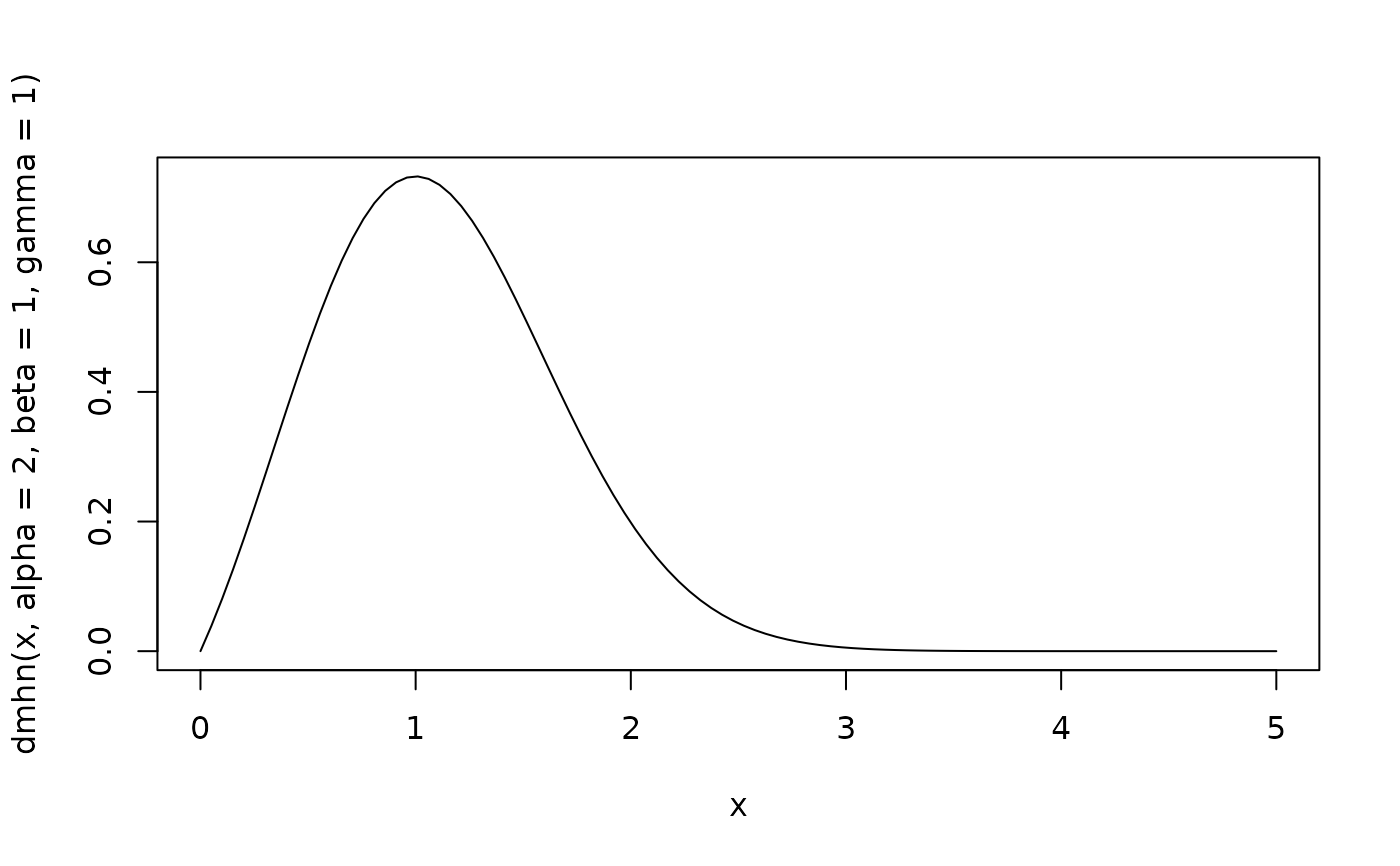
Computes the probability density function (or log-density) of the
Modified Half-Normal (MHN) distribution with parameters alpha,
beta, and gamma.
Arguments
- x
Numeric vector of evaluation points.
- alpha
Shape parameter (\(\alpha > 0\)). Scalar or numeric vector. Default: 1.
- beta
Scale parameter (\(\beta > 0\)). Scalar or numeric vector. Default: 1.
- gamma
Location parameter (\(\gamma \in R\)). Scalar or numeric vector. Default: 0.
- log
Logical; if
TRUE, log-density is returned. Default:FALSE.
Value
A numeric vector. The output length equals
max(length(x), length(alpha), length(beta), length(gamma)); each
input is recycled to that length following standard R recycling rules,
with one exception: a zero-length alpha, beta or
gamma is an error rather than a numeric(0) result. Only a
zero-length x returns numeric(0).
For x < 0, the density is 0 (-Inf if log = TRUE).
Details
The MHN density is $$f(x \mid \alpha, \beta, \gamma) = \frac{2 \beta^{\alpha/2} x^{\alpha-1} \exp(-\beta x^2 + \gamma x)}{\Psi[\alpha/2, \gamma/\sqrt{\beta}]} \quad (x > 0)$$ where \(\Psi[a, z]\) is the Fox-Wright Psi function (Sun et al., 2023, Lemma 1a).
The default parameters alpha = 1, beta = 1, gamma = 0 correspond
to the half-normal distribution \(\mathrm{HN}(1/\sqrt{2})\).
Special cases are detected and dispatched to closed-form solutions:
\(\gamma = 0\): sqrt-Gamma distribution
\(\alpha = 1\): truncated normal distribution
Computation is performed in log-space to avoid numerical underflow/overflow.
When any of alpha, beta, gamma is a vector, the
density is evaluated element-wise. The Fox-Wright \(\Psi\)
normalizing constant is recomputed only when the recycling cycle
presents a distinct \((\alpha, \beta, \gamma)\) triple, so passing
grouped parameters is significantly faster than calling dmhn
inside an R loop.